
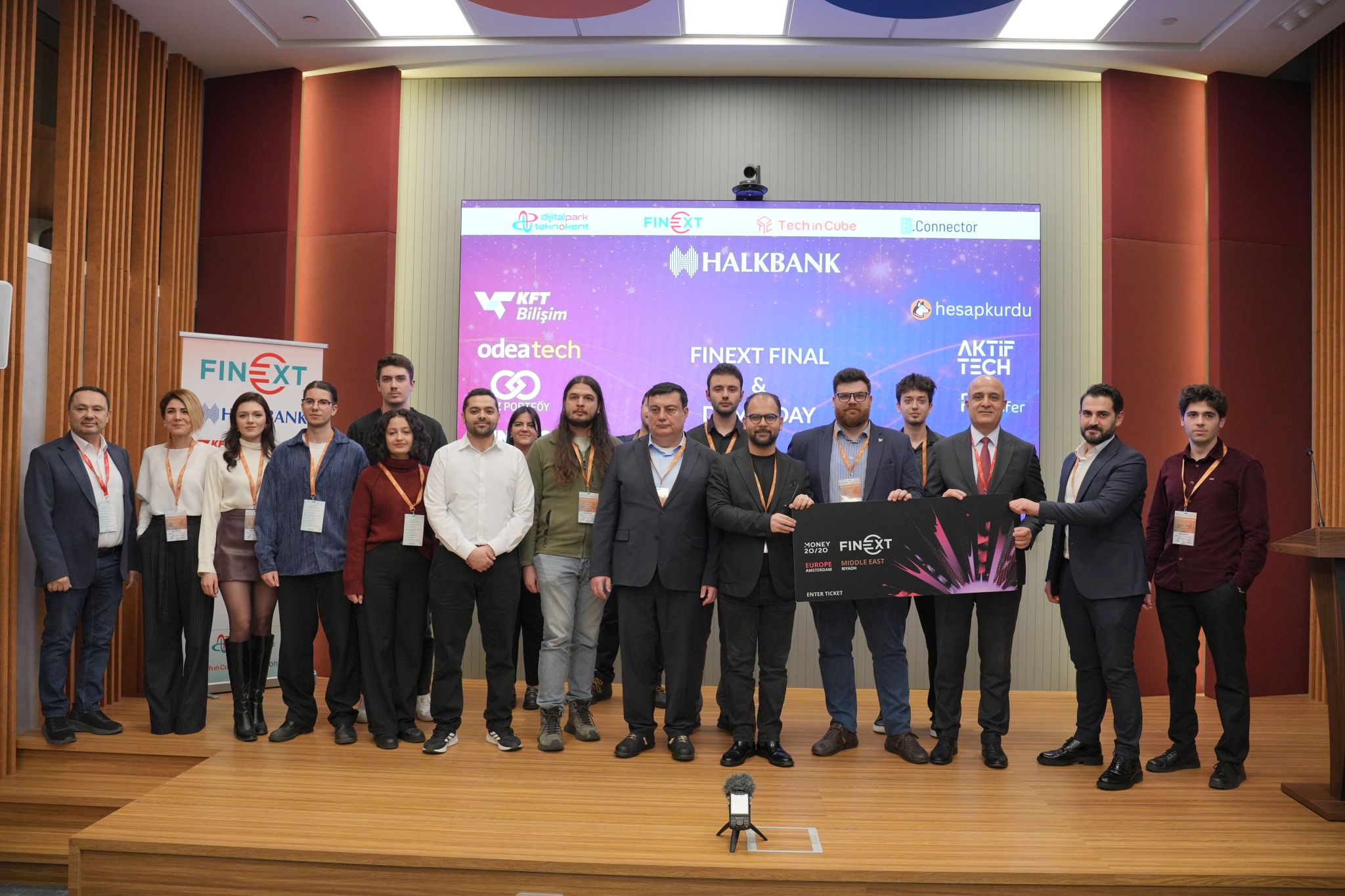
The Finext Acceleration Program, launched in November with the mission of providing a structured roadmap to early-stage fintech ventures, concluded after an intensive 14-week journey. Ten startups took the stage to present their solutions to investors — not only showcasing ideas, but demonstrating operational maturity, regulatory awareness, and scalability readiness.
Organized under the ownership of DİJİTALPARK TEKNOKENT and executed by B-Connector, Finext Demo Day 2026 was more than a graduation event — it was a forward-looking discussion on the future of fintech.
A Clear Globalization Message
Finext Final & Demo Day 2026 was deliberately designed as a “closing and staging” moment — the culmination of a 14-week intensive development cycle. From the opening announcement, the message was clear: startups were stepping onto the investor stage prepared for the next phase.
A strong emphasis was placed on internationalization. The event was broadcast live to a global audience, and the cohort included international founders. This positioning reflected Finext’s evolution from a local acceleration initiative into an emerging international fintech platform.
The day’s core themes were innovation, collaboration, and growth.
Building Platforms, Not Just Events
In his opening remarks, Prof. Dr. Tahsin Engin, General Manager of DİJİTALPARK TEKNOKENT, framed the program not as a one-day showcase but as part of a long-term ecosystem-building effort.
DİJİTALPARK was positioned not merely as a host venue but as a platform where entrepreneurial energy meets corporate needs. The final stage presentations were described as the visible outcome of 14 weeks of disciplined work behind the scenes.
A key message emerged: fintech growth is not driven only by ideas — it is accelerated by platforms that make those ideas visible, connect stakeholders, and create continuity.
The Regulation–Security–Scale Triangle
Mustafa Burak Coşkun, General Manager of KFT Bilişim, emphasized the structural backbone of fintech growth: regulation compliance, operational risk management, and data security — with scalability as the indispensable fourth element.
Security and compliance were not described as barriers to growth, but as prerequisites for sustainable scaling.
Looking ahead, he highlighted forward-facing trends including:
The message was clear: infrastructure discipline is becoming as competitive as product innovation itself.
Execution Over Ideas
Barış Sönmez, CEO of Hesapkurdu, delivered perhaps the most concise founder lesson of the day: execution.
Acceleration programs were framed not as goodwill initiatives, but as innovation engines. Perfect plans do not create outcomes; rapid iteration and disciplined implementation do. The difference between winners and others lies not in avoiding mistakes but in recovering quickly and progressing intelligently.
“No excuses” was the implicit philosophy — resilience under uncertainty defines entrepreneurial success.
2026 Fintech Ecosystem Expectations Panel
One of the most anticipated sessions of the day was the fireside chat titled “2026 Fintech Ecosystem Expectations.”
Moderated by Mehmet Dolgan, CEO of B-Connector-exevution partner of Finext, the session featured Emre Güzer, CEO of Lidio.
The discussion spanned macroeconomic outlook, regulation, embedded finance, AI, consumer expectations, investment climate, stablecoins, and cross-border strategy.
Regulation: Not a Barrier, but an Alignment Mechanism
According to Emre Güzer, 2025 was defined by regulatory adaptation in Türkiye. Strengthened AML frameworks and tighter compliance requirements reinforced trust and risk discipline.
Importantly, this trend was not unique to Türkiye. Global players such as Worldline and Adyen faced similar pressures across regions.
The key takeaway: regulation aligns the ecosystem and creates the framework for healthy scaling.
Fintech Became Invisible — Infrastructure Moved to the Center
A pivotal shift highlighted during the panel was the movement of competition from wallets and front-end experiences to infrastructure and embedded finance layers.
Fintech players are becoming invisible components within larger ecosystems — functioning like modules inside a broader operating system rather than standalone consumer brands.
Open banking licenses and PSD2-style regulations are accelerating this transition.
The New Benchmark: Netflix, Uber, Amazon
Consumer expectations are no longer benchmarked against other fintechs. They are benchmarked against digital giants like Netflix, Uber, and Amazon.
Speed, transparency, reliability, and instant results define the new standard. Regulation sets the floor — consumer behavior sets the ceiling.
AI Entered the Field in Three Core Areas
Unlike the blockchain investment wave, which largely centered around exchanges, AI adoption in fintech is becoming operational and measurable.
Three dominant use cases emerged:
Monitoring systems are shifting from rule-based to behavior-based, real-time signal models. Particularly in regtech, AI enables global expansion with leaner operational footprints.
AI as the Payment Orchestration Layer
One of the most forward-looking projections concerned AI’s future role in payment orchestration.
In complex cross-border transactions — for example, global airline ticket sales — AI will increasingly decide which payment rail, scheme, or method to use based on conversion rates and cost optimization.
This introduces ethical questions: whose interest does the AI optimize for — the merchant, the user, or the payment provider? Competition authorities are beginning to monitor this emerging decision layer.
The Rise of the Hybrid Thinker
Pure engineering capability is no longer sufficient. The industry now demands hybrid thinkers — professionals combining technical depth, regulatory literacy, product understanding, and problem-solving agility.
Interdisciplinary talent is becoming a core strategic asset.
Investment Climate: EBITDA and Cash Flow Matter
Globally and locally, investors have shifted focus from pure revenue growth to cash flow discipline, gross margins, and EBITDA performance.
In Türkiye, a large domestic market creates comfort — but also risk. Companies may remain locally focused instead of building global footprints. Funding in the $1M–$5M range has become more challenging, reinforcing the need for cross-border strategy.
Stablecoins and Cross-Border Infrastructure
Stablecoins are increasingly embedded in remittance and cross-border flows. End-users may not even notice the infrastructure shift happening behind the scenes.
To remain competitive in cross-border finance, Türkiye needs a clear and actionable stablecoin strategy.
AI Governance Remains Immature
While AI is actively used in customer support and risk monitoring, the ecosystem is not yet fully prepared for AI governance and regulatory oversight.
Sensitive data management, model risk, transparency, and AI supervision remain emerging areas requiring structured frameworks.
The 2026 Competitive Landscape
The overarching conclusion of the panel was clear:
Competition in 2026 will not revolve around a single product idea.
It will intensify around:
Against this backdrop, the Demo Day stage carried greater meaning. Startups presented not just ideas — but structured approaches aligned with the realities of scale, compliance, and operational discipline.
Startups on Stage – Finext Demo Day 2026
These 10 startups were awarded for Money 20/20 event tickets.
Finext Demo Day 2026 concluded following the startup presentations — marking not an end, but the beginning of the next scaling phase.
Finext: More Than a Program
Finext continues to evolve as a multi-layered ecosystem initiative including:
With the strong institutional backing of DİJİTALPARK TEKNOKENT and Halkbank, and the structured execution approach of B-Connector, Finext is positioning itself as one of Türkiye’s most disciplined fintech growth platforms.